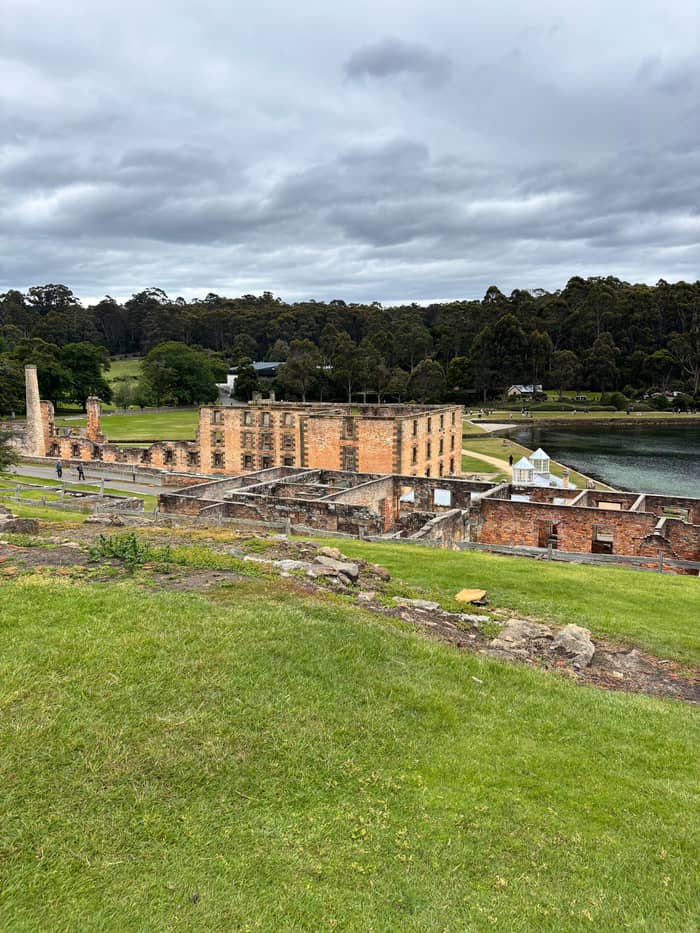
Mason Cove, 1840
Private Robert Young
Soldier, aged 20
Meet them on siteChoose your stop
Browse 23 stops
Start by picking a route; tap a pin or stop for its note and Google Maps.
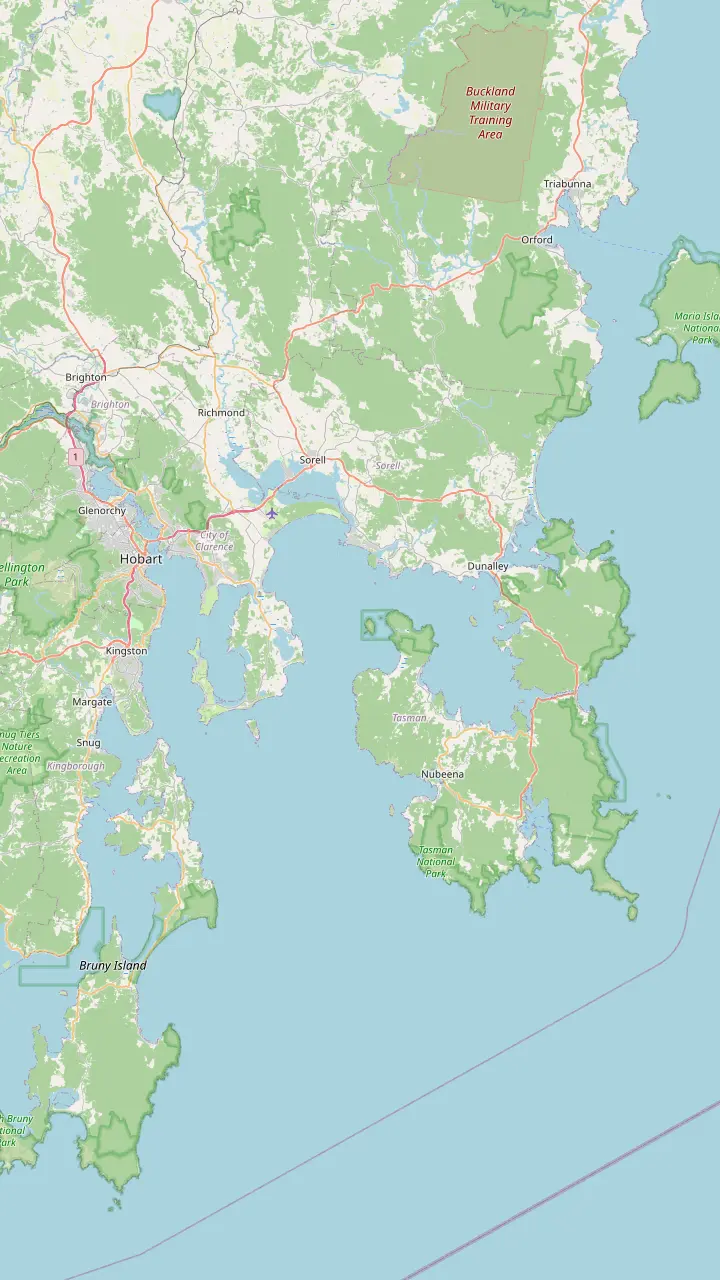
Leave Hobart on the Tasman Highway (A3) over the Tasman Bridge; Tassielink route 734 starts in Elizabeth Street.
Google MapsSorell lies 27 km from Hobart; here the signs send you onto the Arthur Highway (A9).
Google MapsDunalley is 30 km past Sorell; cross the canal bridge and the turn-off to the site comes 44 km later.
Google MapsEaglehawk Neck has the Dog Line sculpture and the Officers' Quarters of 1832.
Google MapsNubeena is where the Tassielink route to Hobart now begins, travelling via Port Arthur.
Google MapsThe historic site opens daily from 9:00am to 5:00pm and is closed on Christmas Day.
Google Maps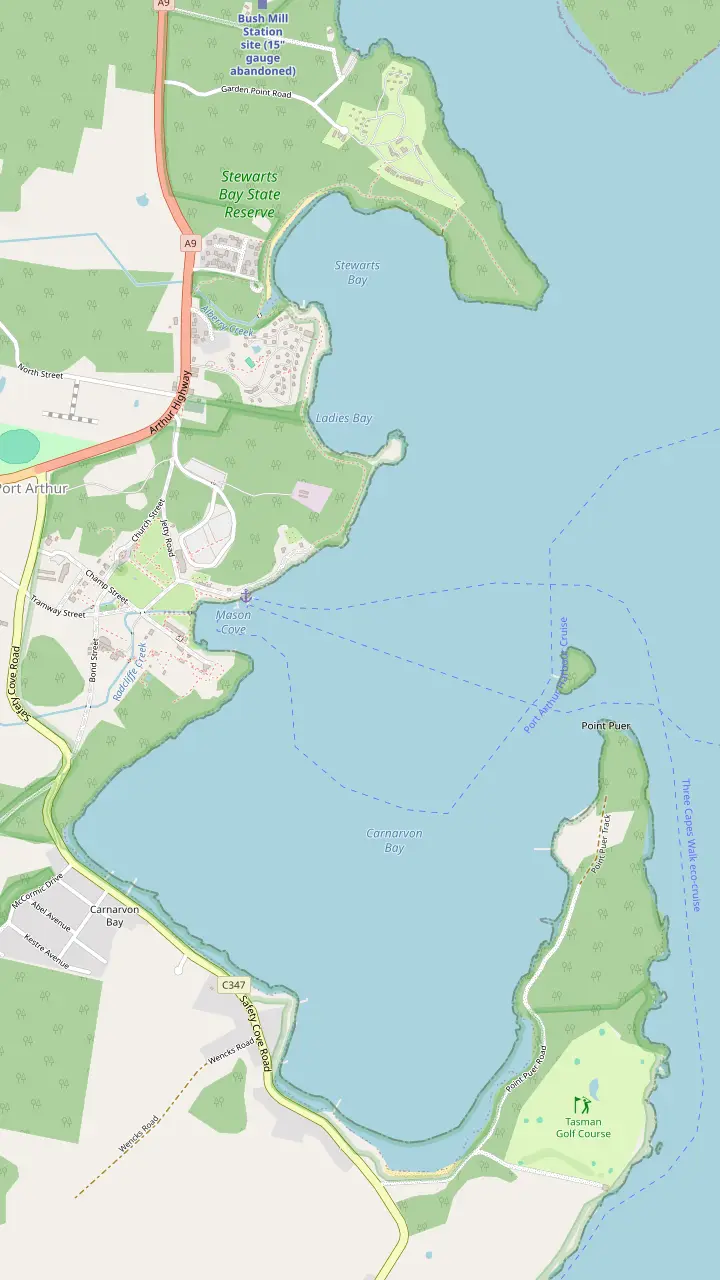
The Penitentiary began as a flour mill and granary and was turned into a prison between 1854 and 1857.
Google MapsThe Guard Tower is one of the convict-era ruins inside the historic site.
Google MapsThe Commandant's House is one of the site's furnished museum houses.
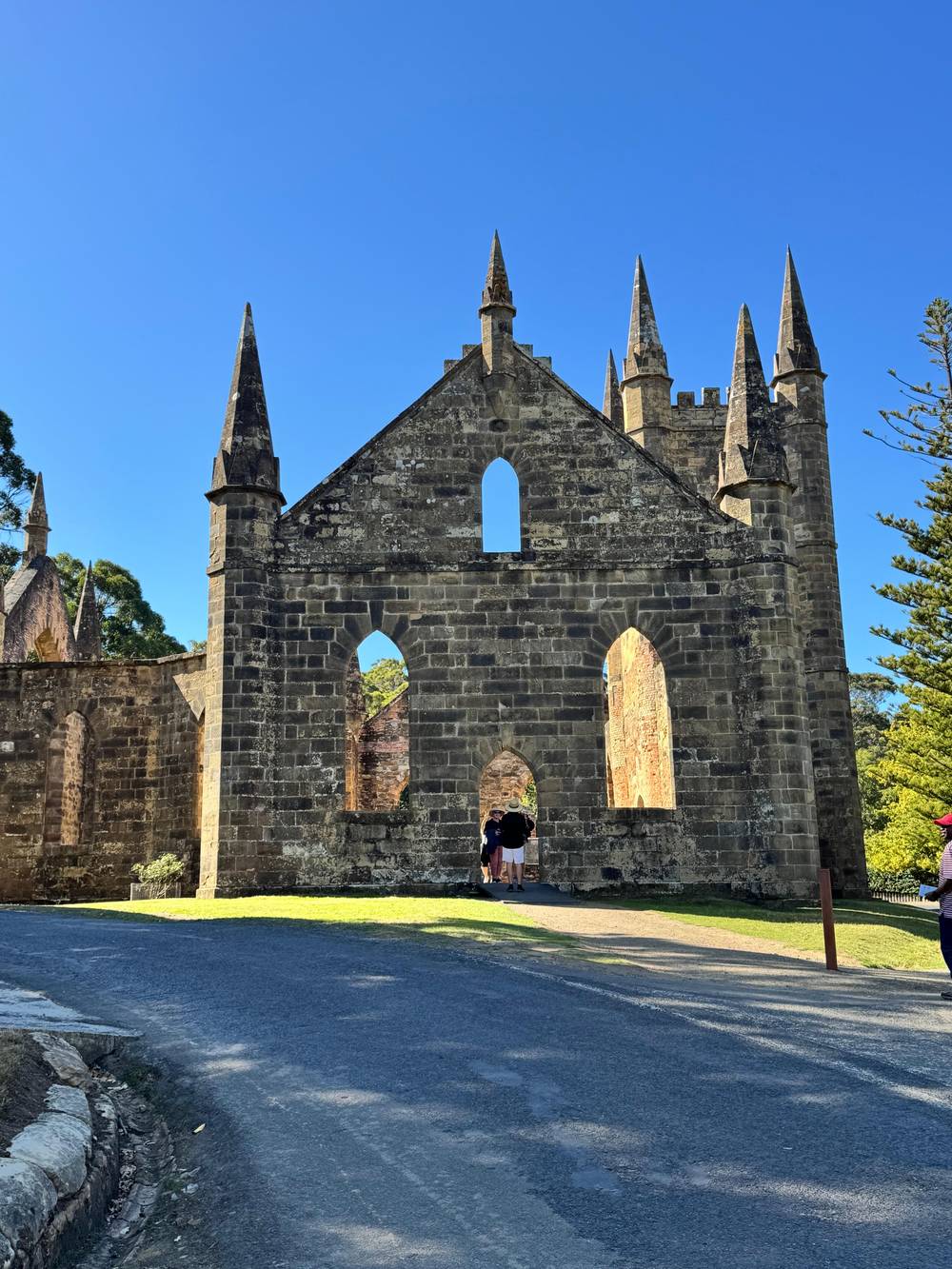
Google MapsThe Convict Church stands without a roof, and its bells ring every hour.
Google MapsThe Asylum, begun in 1864, now houses the quieter cafe.
Google MapsThe Memorial Garden is a quiet place of remembrance near the Visitor Centre.
Google MapsThe Isle of the Dead holds more than 1,000 burials from 1833 to 1877.
Google MapsPoint Puer was the British Empire's first institution built to reform convict boys.
Google Maps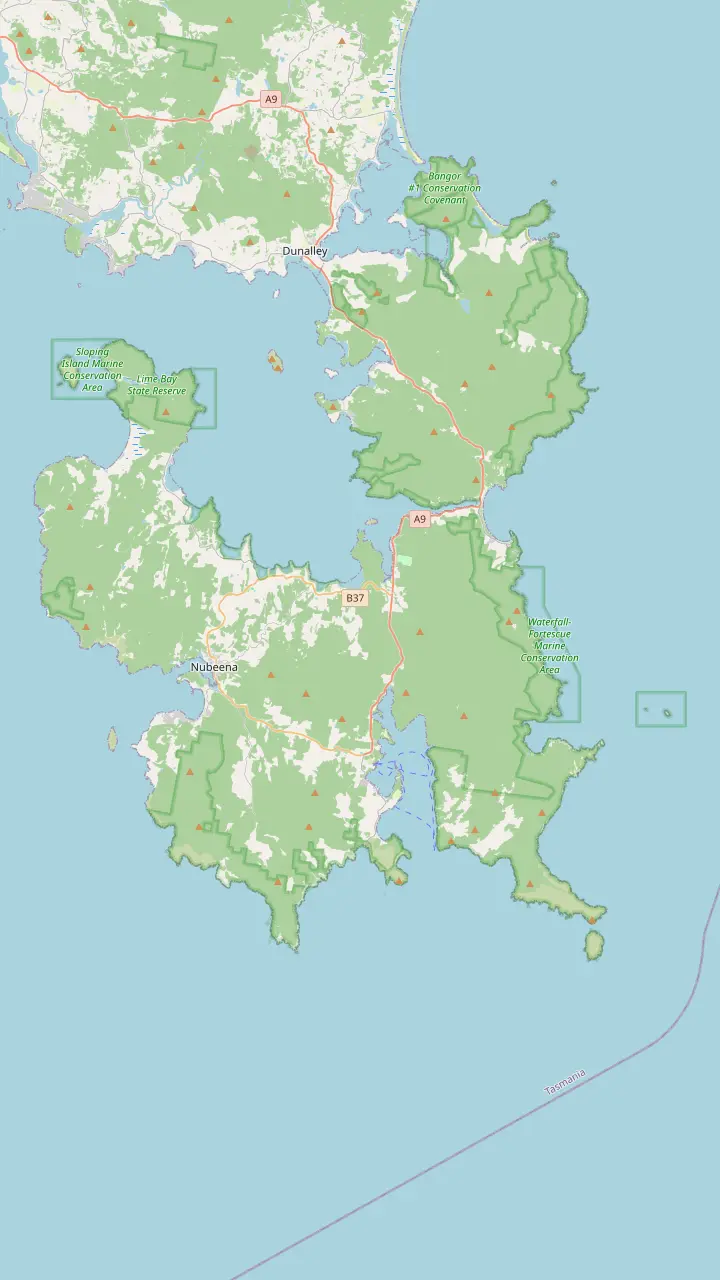
The Tessellated Pavement is best seen at low tide.
Google MapsThe Blowhole is reached by a wide loop track with a few stairs.
Google MapsDevils Kitchen and Tasmans Arch share a 600m sealed circuit of 20 minutes.
Google MapsDoo Town's shacks carry playful Doo names, a habit begun in 1935.
Google MapsThe Tasmanian Devil Unzoo opens every day at 9 am.
Google MapsPort Arthur Lavender sits at 6555 Arthur Highway, above Long Bay.
Google MapsRemarkable Cave is 115 steps down from its car park.
Google MapsThe Coal Mines Historic Site is free to enter.
Google MapsFortescue Bay is 12km of unsealed road off the highway and the start of the Cape Hauy walk.
Google MapsMap © OpenStreetMap contributors
The history of Port Arthur runs from a timber camp in 1830 to a prison for re-offenders, a boys' prison, a failed mill and a tourist town. These are the people, buildings and dates that explain the ruins.
Editorial team, portarthurtour.quest · Updated November 8, 2026 · ~8 min read
Port Arthur opened in 1830 as a modest timber-getting station, and within a few years it had become a key part of the colonial prison system.1,6 The place was chosen for its naturally deep and sheltered harbour.7 The site's own account adds that cold, deep water, dense forest and sea cliffs 300-metre high turned the whole peninsula into a natural jail.8 Before any of this, the Tasman Peninsula was the homeland of the Pydairerme, a clan of the Oyster Bay nation.9
Port Arthur was built for a particular kind of prisoner. It is one of only a handful of colonial penal stations built specifically for recidivists, men who had offended again.10 The Australian Government's World Heritage summary describes it as a feared posting for convicts who reoffended, where both body and mind were broken down.11 Its isolation and formidable geography, in the heritage listing's words, gave it a feared reputation.12
The settlement grew fast. By the 1840s its convict population had reached over 1100, and after the probation system arrived in 1841 the peninsula's convict count climbed from nearly 1500 to more than 3500 by 1844.13,14 Feeding that many men took over 2.5 ton of flour a day for the bread ration alone.15 That is the background to the great flour mill that later became the Penitentiary, the building every visitor photographs today.
The phases
| Years | Phase | What it left behind |
|---|---|---|
| 1830s | Timber station and shipyard | The dockyard site |
| 1840s | Industrial prison | The mill, later the Penitentiary |
| 1848 on | Punishment of the mind | The Separate Prison |
| 1860s | Welfare phase | The Asylum |
| 1877 on | Carnarvon township | Houses and gardens |
| 1916 on | Scenic reserve, then historic site | Conserved ruins |
Dates from the site's timeline: the timber station of 1830, the mill of 1842, the Separate Prison of 1848, the Asylum of 1864-68, the closure of 1877 and the reserve of 1916.1,34,17,35,4,36
After the American War of Independence closed America to them, Britain transported its convicts to the Australian colonies from 1788.20 Most had committed crimes that look petty now, often the theft of small goods or animals, but every one of them had a previous conviction.21 Those sent to Van Diemen's Land were most likely poor young people from the countryside or the city slums, and few ever returned home.22 One in five was a woman.23
Transportation was not only for adults. The penalty also applied to children from the age of nine.24 In the years from 1830 to 1877, roughly 12,500 convicts passed through Port Arthur under sentence.2 On arrival each was given a uniform that had to last six months, its outer suit yellow or parti-coloured, half yellow and half black, so that everyone knew who the prisoners were.25 Smoking was banned, except on Christmas Day, when the men were handed tea, sugar or tobacco.26
The site keeps the stories of individuals. William Riley was sent out in 1821, aged 14, on a sentence of seven years; years later, at Port Arthur, he killed a fellow convict with a pickaxe while building the church.27,28 Henry Singleton, sent here in 1853, refused to work and spent more than one spell in solitary confinement.29 William Thompson, a young shoemaker transported for life in 1841, served a year in the underground cells of the Coal Mines first.30
Scale
Port Arthur was meant to pay its way, and its heritage listing describes it as an industrial establishment making goods for government and private markets.45 Timber came first. A gang of up to 50 men, nicknamed the centipede gang, carried rough beams on their shoulders back to the settlement.46 The convicts were also given skilled jobs such as brick making, carpentry and shoemaking.47 In 1832 the shoemakers sent out 400 pairs of shoes and boots.48
Ship building began on a large scale in 1834, to give selected convicts a skill they could use once free.16 The two official accounts differ slightly on the output: the timeline gives fifteen large ships and over 140 smaller vessels, while the dockyard guide gives 16 big decked ships and some 150 small open boats.49,50 At its peak the yard may have employed up to 70 men, adult convicts and Point Puer boys among them.51,52 The 270-ton Lady Franklin, built here, gave over 40 years of service.53
The dockyard closed in 1848, not for poor work: free shipwrights claimed it undercut them.50,54 Communication was another feat. Commandant Charles O'Hara Booth set up his first signal post in 1833, and by 1836 a message could reach Hobart within 15 minutes along a chain of semaphores.55,56 The code used almost 3000 numbers, and the system stayed the main link with Hobart until the electric telegraph arrived in the 1860s.57,58
Follow your interest
Pick what pulls you in and go straight to it.
If Escapes and the Dog Line
Escape from Port Arthur tour
It runs 60 minutes at 11:00am or 3:00pm.41
If The great buildings
Premium Tour
Its route takes in the Penitentiary, the Separate Prison and the Convict Church.42
If The graves and the stories
Isle of the Dead tour
It takes 65 minutes: the boat out, then 45 minutes ashore.43
If The boys' prison
Harbour cruise
The cruise in the entry ticket passes Point Puer.
If Everything, on a budget
Free audio guide
Eight episodes, each around five minutes long.44
Three lives
Mason Cove, 1840
Soldier, aged 20
Meet them on site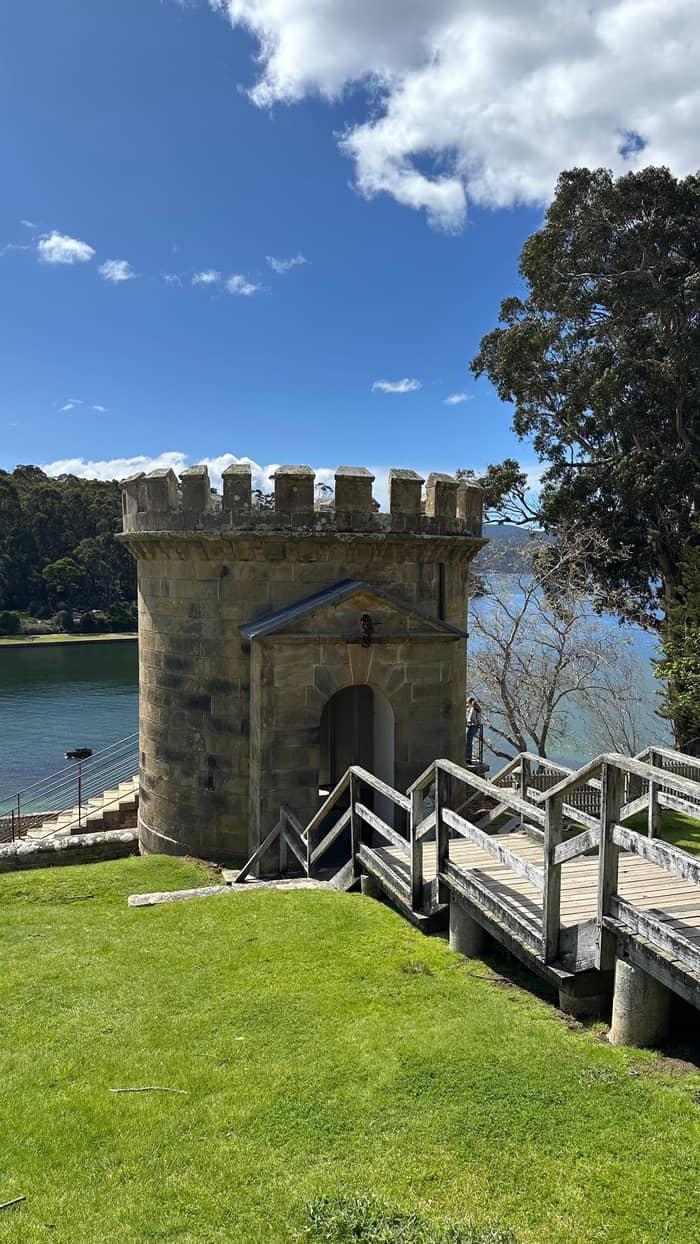
Convict
Transported at 14
Meet them on site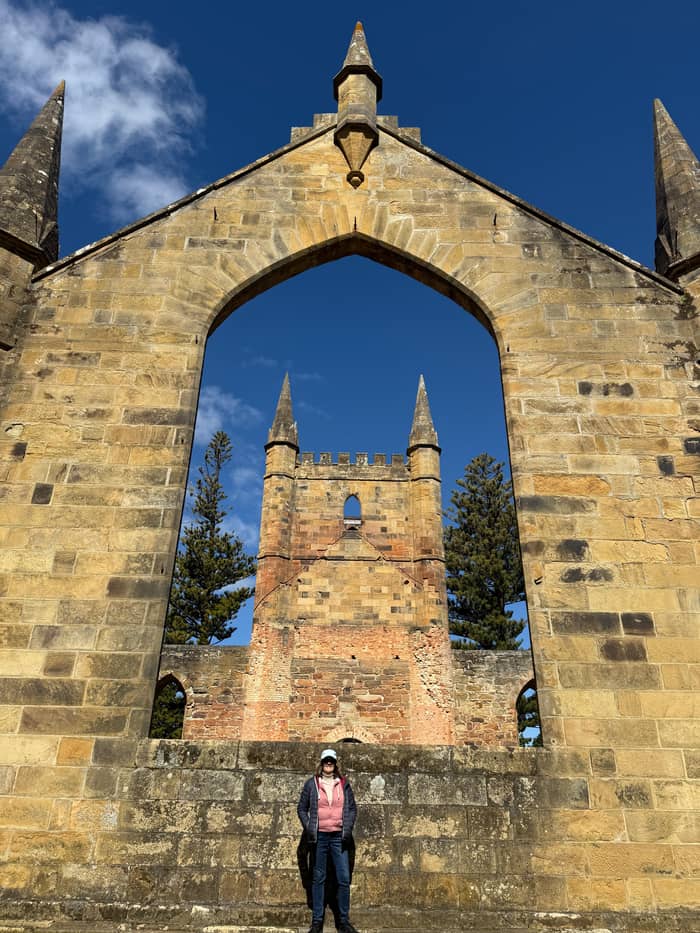
Isle of the Dead
Convict gravedigger
Meet them on siteIn 1848 corporal punishment ceased at Port Arthur and a separate prison was built, aimed at the mind rather than the body.91 Its regime was one of separation and silence, with each convict in his own cell.92 The site's timeline frames the same change as a move away from breaking the body towards breaking the mind.17 The convict Mark Jeffrey was held there for six months after standing up for his rights over rations.39 He was later sent to the Isle of the Dead to work as its gravedigger.40
Across the water stood something new in the British Empire. According to the site's heritage values, Point Puer was the Empire's first institution built from scratch to reform convict boys.76 The Australian Government estimates that 3,000 juvenile convicts were housed there; Discover Tasmania says more than 3000.93,94 The boys laboured in work gangs, were taught a trade, and had lessons in reading and religion.95
Point Puer appears in the smaller stories too. In 1840 a 20-year-old soldier, Private Robert Young, went across with the doctor to treat an ill boy at Point Puer; on the return, in the dark, he fell into the freezing waters of Mason Cove.37,38 Conservation funding in the 1980s opened the boys' prison for guided tours, and the harbour cruise included in every entry ticket passes it.96 It has limited shelter, so dress for the wind.97
Key dates
1830
The penal settlement began as a small timber station.1
1834
Ship building began on a large scale.16
1848
The first stone was laid for the Separate Prison.17
1853
Fewer transportees arrived after transportation ceased.18
1877
The last convict was shipped out.4
2010
The convict sites joined the World Heritage List.19
Port Arthur was placed to make escape close to impossible: wild sea all round, and only the narrow isthmus at Eaglehawk Neck to guard by land.98 At the Neck a line of fierce dogs was tethered across the isthmus to change the minds of would-be escapees.99 The Officers' Quarters there, built in 1832, belonged to the small military post that guarded it, and the building is reckoned the oldest military one surviving in Australia.65
Still, men tried. The bushranger Martin Cash got past the dog line by simply detouring out to sea.100 The site's Escape from Port Arthur tour retells these attempts, from clever disguises to the dreaded dogs, over 60 minutes at 11:00am or 3:00pm.101,41 The tour is the best place to hear the attempts one by one, from the clever to the hopeless, and to judge for yourself whether you would have run.
A sculpture now stands at the Neck, marking where the barricade was.64 Several day tours from Hobart stop here: the site tour's itinerary includes a 15-minute photo stop at Eaglehawk Neck, and the Tasman Sights day stops at the Dog Line itself. Standing on that narrow strip of land makes it easy to see why the guards needed only one line to hold a whole peninsula.
Video
Geographics on YouTube · The clip loads only after you tap play.
Deep, cold ocean, thick forest and 300-metre high sea cliffs made Port Arthur a natural prison from which escape must have seemed impossible
History on the ground
Transportation ceased in 1853, but Port Arthur kept receiving men sentenced in the colony.18 In 1852 the transfer of Norfolk Island's convicts to the peninsula made space pressing, and the decade after 1856 was the busiest in Port Arthur's history.102,103 Then the population aged. The Pauper's Depot of 1863-64 and the Asylum of 1864-68 cared for old and infirm prisoners.35 When did Port Arthur close? The last convict was shipped out in 1877.4
The site was almost immediately renamed Carnarvon, and in the 1880s its land was parcelled up and sold at auction.104 Fires in 1895 and 1897 destroyed many old buildings and gutted the Penitentiary, the Separate Prison and the Hospital.105 In the Penitentiary's case the 1897 fire left only the masonry walls and barred windows standing.106 The first tourists came with the closure, and by the 1920s and 1930s the area had three hotels and two museums.107,108 The name Port Arthur was reinstated in 1927.109
On Sunday 28 April 1996 a gunman killed 35 people at Port Arthur.110,111 The tragedy led to changes in Australia's gun laws, among the strictest in the world.112,113 Many staff lost friends, colleagues and family that day, and the site asks visitors to turn to the plaque in the Memorial Garden, or a brochure, instead of asking a guide.114 The Gallery in the Visitor Centre also holds information for anyone who wants to understand that day.74
The Australian Convict Sites joined the World Heritage List on 31 July 2010, Australia's 18th entry.5 Port Arthur is one of 11 places in that listing, together with the Coal Mines and the Cascades Female Factory.115 Almost half of the listed sites are in Tasmania.116 Together they stand for convictism, the shipping of prisoners to distant penal colonies through the 18th and 19th centuries.117 Port Arthur was already on the National Heritage List, from 3 June 2005.118
So why is Port Arthur a World Heritage site? Its own heritage values present it as an outstanding case of how 19th-century European powers built empires on forced convict labour.119 Several of its institutions broke new ground in penal and social practice: the boys' prison at Point Puer, the Dockyard, the Separate Prison, the Asylum and the depot for paupers.120 The Australian Government notes that more than 3000 convict sites remain around Australia, and the listed ones are the preeminent examples.121
The listing also covers what came after the convicts. After closure in 1877 the site became the cradle of Tasmanian tourism, and it is now called the best-known symbol of Australia's convict past.122,123 Writers drawn here included Anthony Trollope, Marcus Clarke and Mark Twain.124 Even the science counts: Lemprière's tidal benchmark has exceptional significance in international climate research.125
FAQ
It started in 1830 as a small station for cutting timber.1
Fires in 1895 and 1897 gutted the Penitentiary, the Separate Prison and the Hospital.105
Roughly 12,500 convicts served time there from 1830 to 1877.2
It was the British Empire's first institution built to reform convict boys.76
Sources
Also worth reading
Planning a day at Port Arthur? A real person answers here.