Most freedom
On your own
Entry with audio
Plan this visitChoose your stop
Browse 23 stops
Start by picking a route; tap a pin or stop for its note and Google Maps.
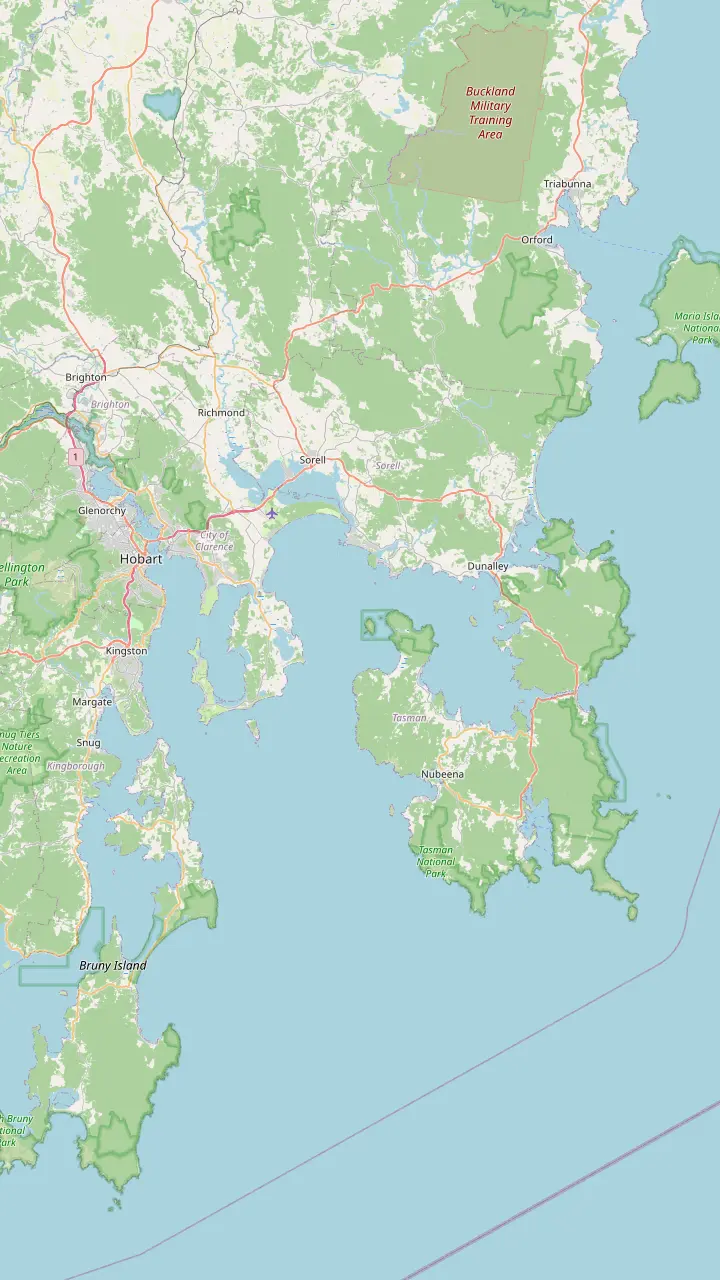
Leave Hobart on the Tasman Highway (A3) over the Tasman Bridge; Tassielink route 734 starts in Elizabeth Street.
Google MapsSorell lies 27 km from Hobart; here the signs send you onto the Arthur Highway (A9).
Google MapsDunalley is 30 km past Sorell; cross the canal bridge and the turn-off to the site comes 44 km later.
Google MapsEaglehawk Neck has the Dog Line sculpture and the Officers' Quarters of 1832.
Google MapsNubeena is where the Tassielink route to Hobart now begins, travelling via Port Arthur.
Google MapsThe historic site opens daily from 9:00am to 5:00pm and is closed on Christmas Day.
Google Maps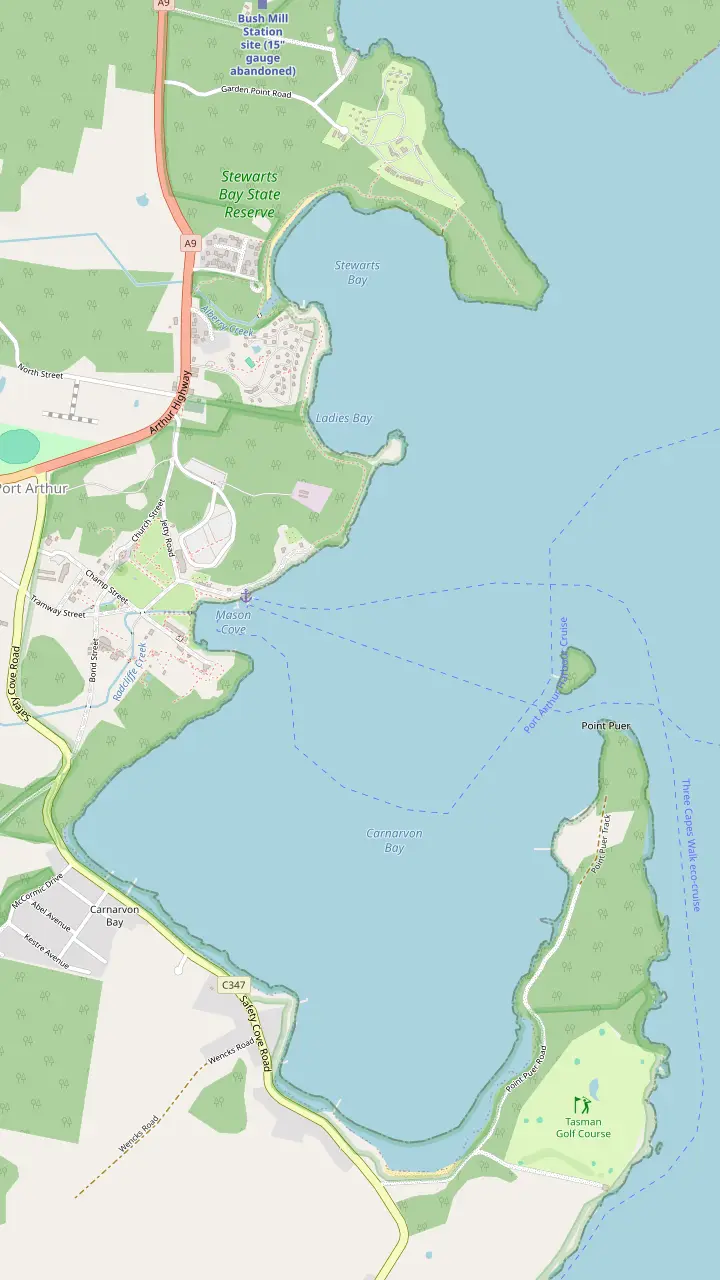
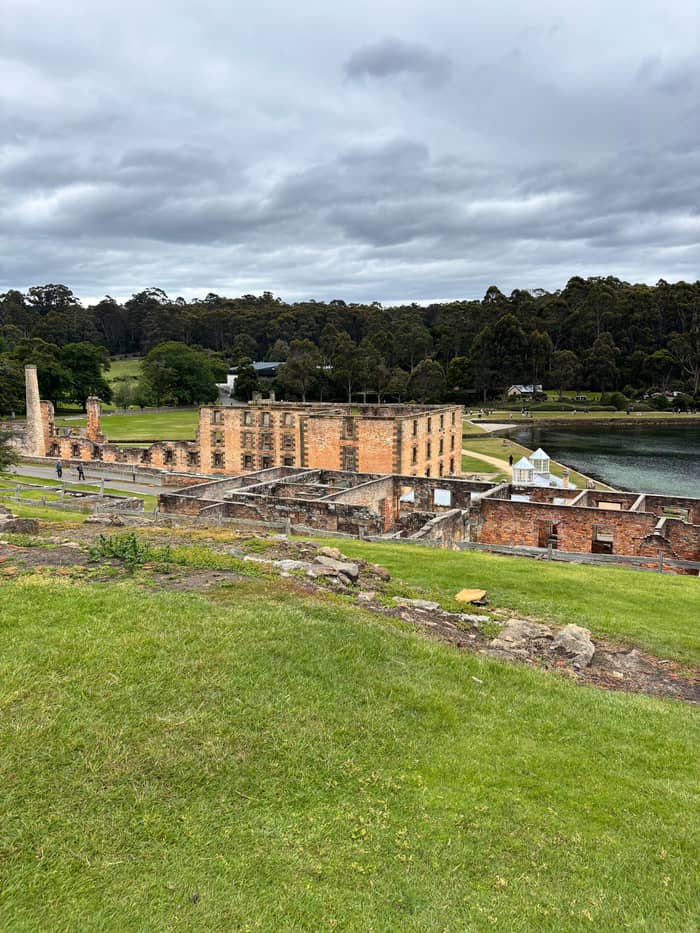
The Penitentiary began as a flour mill and granary and was turned into a prison between 1854 and 1857.
Google MapsThe Guard Tower is one of the convict-era ruins inside the historic site.
Google MapsThe Commandant's House is one of the site's furnished museum houses.
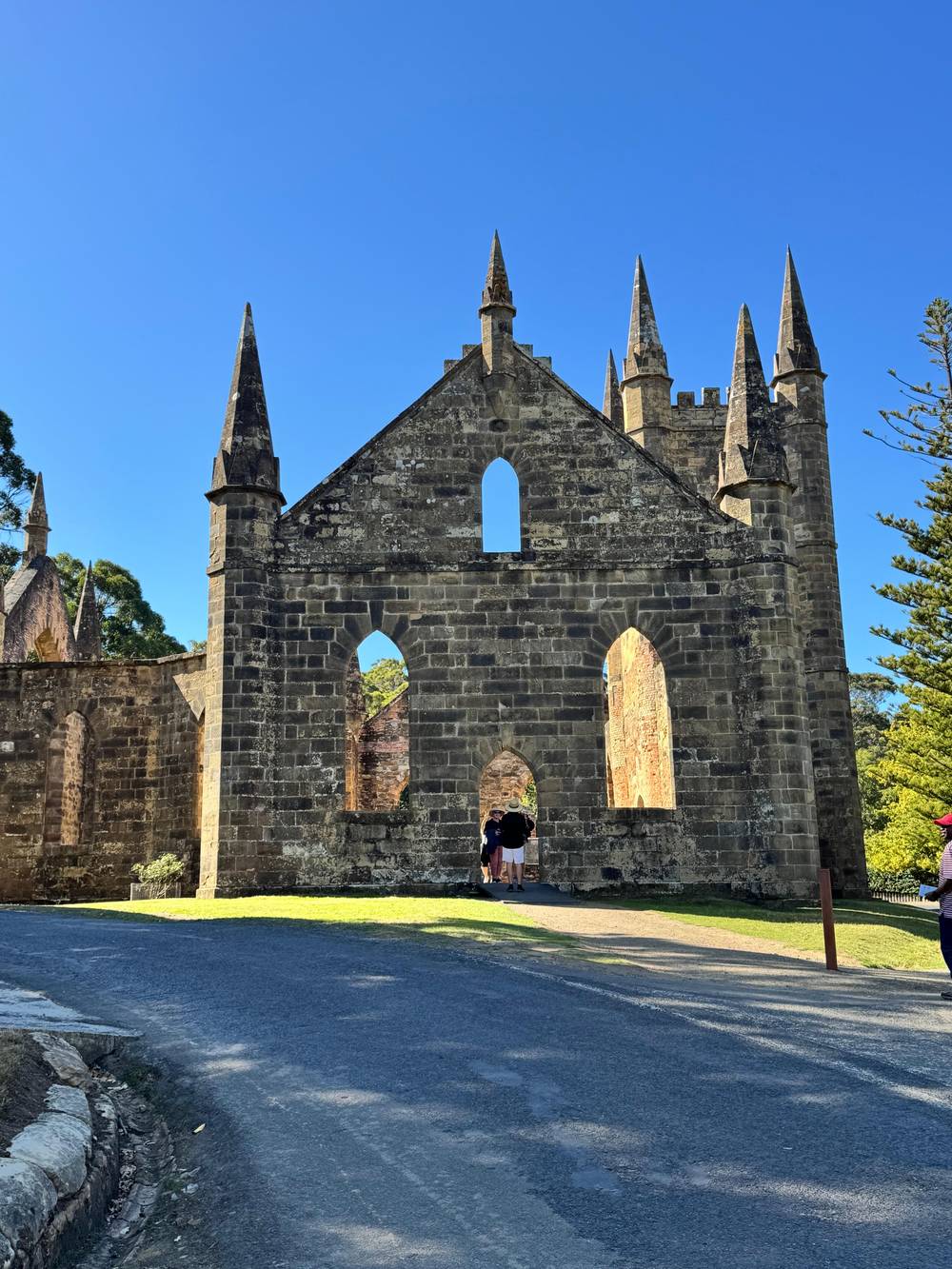
Google MapsThe Convict Church stands without a roof, and its bells ring every hour.
Google MapsThe Asylum, begun in 1864, now houses the quieter cafe.
Google MapsThe Memorial Garden is a quiet place of remembrance near the Visitor Centre.
Google MapsThe Isle of the Dead holds more than 1,000 burials from 1833 to 1877.
Google MapsPoint Puer was the British Empire's first institution built to reform convict boys.
Google Maps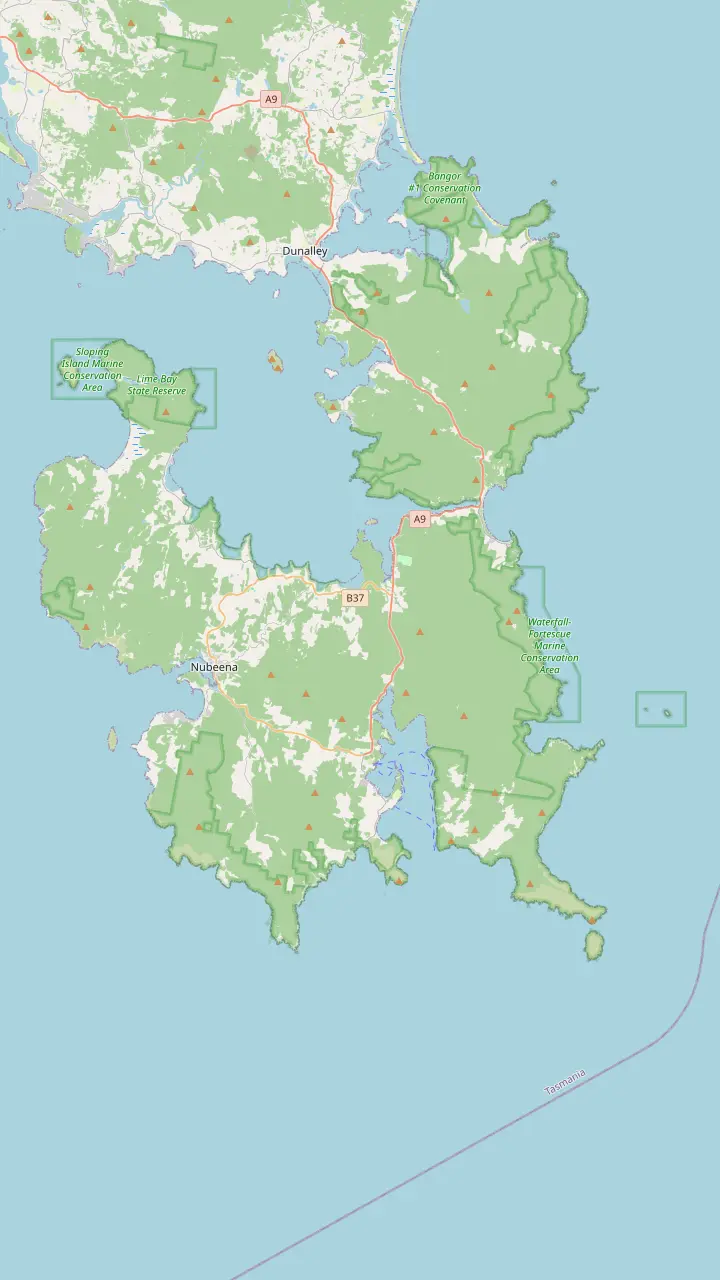
The Tessellated Pavement is best seen at low tide.
Google MapsThe Blowhole is reached by a wide loop track with a few stairs.
Google MapsDevils Kitchen and Tasmans Arch share a 600m sealed circuit of 20 minutes.
Google MapsDoo Town's shacks carry playful Doo names, a habit begun in 1935.
Google MapsThe Tasmanian Devil Unzoo opens every day at 9 am.
Google MapsPort Arthur Lavender sits at 6555 Arthur Highway, above Long Bay.
Google MapsRemarkable Cave is 115 steps down from its car park.
Google MapsThe Coal Mines Historic Site is free to enter.
Google MapsFortescue Bay is 12km of unsealed road off the highway and the start of the Cape Hauy walk.
Google MapsMap © OpenStreetMap contributors
Port Arthur Historic Site scatters over 30 ruins, buildings and furnished museum houses across its landscaped grounds. Here is what each one was, the order to walk them, how long to allow and where to eat.
Editorial team, portarthurtour.quest · Updated November 8, 2026 · ~8 min read
Facts at a glance
Every visit begins in the Visitor Centre, and the Gallery on its lower level is where the site suggests you start, with a large map and a welcome video.7 Pick up the playing card handed out there: each one introduces you to a person from the site's past, and the card links to displays in the Gallery and out in the grounds.8 Following one life through the day turns a walk past ruins into a story with a beginning and an end.
Practical details first. The site takes card payments only, so buy your ticket online and carry a card for food and gifts.9 Tours run only in English, while printed visitor guides come in English and Simplified Chinese.10 The free Port Arthur audio tour, which the site calls its Audio Experience, has eight episodes of about five minutes each, and each episode comes with a suggested spot on the site to hear it.11,12
The audio is also offered in French, Japanese and Mandarin, and it is easiest to download before you arrive.13 Free Wi-Fi called PAHSMA Public covers the site if you forgot.14 Then look at the day's list of guide talks: these 10-15 minute talks are free for all daytime visitors, and their locations and times change daily, so a quick look at the schedule shapes your route better than any map.5,15
Building by building
| Building | What it was | Look for |
|---|---|---|
| Penitentiary | Flour mill turned prison | The barred windows |
| Separate Prison | Prison of separation and silence | The individual cells |
| Convict Church | The settlement's church | The missing roof |
| Commandant's House | The commandant's home | Furnished rooms |
| Government Gardens | Officers' pleasure garden | Rebuilt beds and lawns |
| Asylum | Welfare-era asylum | The quieter cafe |
| Dockyard | Shipyard, 1834 to 1848 | The old slipway site |
The mill became the Penitentiary in 1854-1857; the Separate Prison dates from 1848; the gardens from 1846-47; the Asylum was begun in 1864; the dockyard ran from 1834 to 1848.21,37,38,39,40
The great brick shell by the water did not start as a prison. It was built as a flour mill and granary, the mill failed for want of water, and between 1854 and 1857 it was converted into the Penitentiary that became the site's most enduring landmark.21 When it worked, the mill had a treadmill that could take up to 56 convicts at once.22 Superintendent Latrobe once counted 36 prisoners on the treadmill at a time.23
Inside the converted building, the bottom two floors held 136 separate cells, while about 480 better-behaved men slept in a dormitory on the top floor.16,24 Men in heavy irons were held on the ground floor and those in lighter irons on the first floor.25 Each cell measured approximately 1.35m x 2.1m, and held a stool, a small keg of water, a tin cup and often a bible.26,27 Picture a man living for years in a space that size, and the scale of that life becomes very plain.
A newspaper visitor in 1870 wrote that the interior looked more like a mansion than a house of correction.28 Fire in 1897 reduced it to its masonry walls and barred windows, which is the ruin you see now.29 Many of its bricks were later carried off to build local houses and sheds.30 The Penitentiary, the Convict Church and the Separate Prison were the first buildings gazetted as part of a scenic reserve, in 1916.31
Time on site
The Separate Prison is where Port Arthur changed its method. The first stone was laid in 1848, and the building marked a shift in punishment from the body to the mind.37 The federal government's World Heritage summary speaks of a rigid regime of separation and silence, with convicts housed in individual cells.48 It is the most unsettling building on the site, and the one where the place's old nickname makes sense.
The audio guide calls Port Arthur Hell on Earth and suggests hearing its punishment episode just outside the Separate Prison.20 Allow time inside to sit in the quiet. Guide talks are held at buildings such as the Penitentiary, the Convict Church and the Separate Prison, and their times change daily, so it is worth timing your arrival here to meet one.49,15 The guided Premium Tour of 90 minutes, limited to 15 people, also walks through the Penitentiary, Separate Prison and Convict Church.36,42,50
Up the slope, the Convict Church stands without a roof. The site has chosen not to rebuild it, reasoning that it is still clearly a church even without one.18 Its bells ring every hour across the grounds.19 The building carries a hard story: in 1833 the convict William Riley killed Joseph Shuttleworth with a pickaxe while both were at work building the church.51 Read the panels, then step outside and take in the view down to the harbour.
Plan your visit
Match your time, your legs and your curiosity to a way round the site.
If We only have the morning
Penitentiary, cruise and one talk
Cruise ship passengers return around midday, so keep to the waterfront and the 20-minute cruise.43,4
If I want the stories explained
Book a guided tour
The Essentials Tour lasts about 45 minutes; the Premium Tour 90.41,36
If I like to wander alone
Download the audio first
It has eight short episodes with suggested places to listen.11
If We have small children
Bring or hire a pram
If Walking is hard for me
Use the buggies
They run 10:30am to 3:30pm around the site.6
If We want everything
Split it over two days
Entry is valid for two consecutive days.46
Three ways to see it
Most freedom
Entry with audio
Plan this visit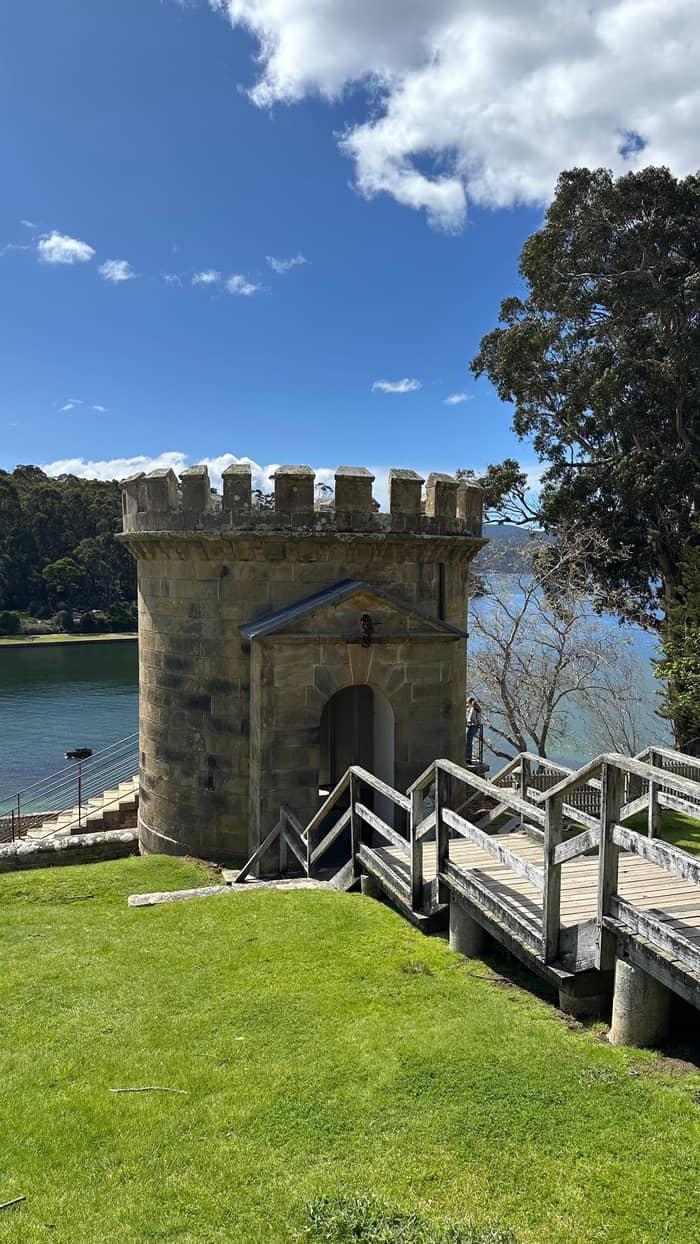
Easy walking
Short and flat
Plan this visit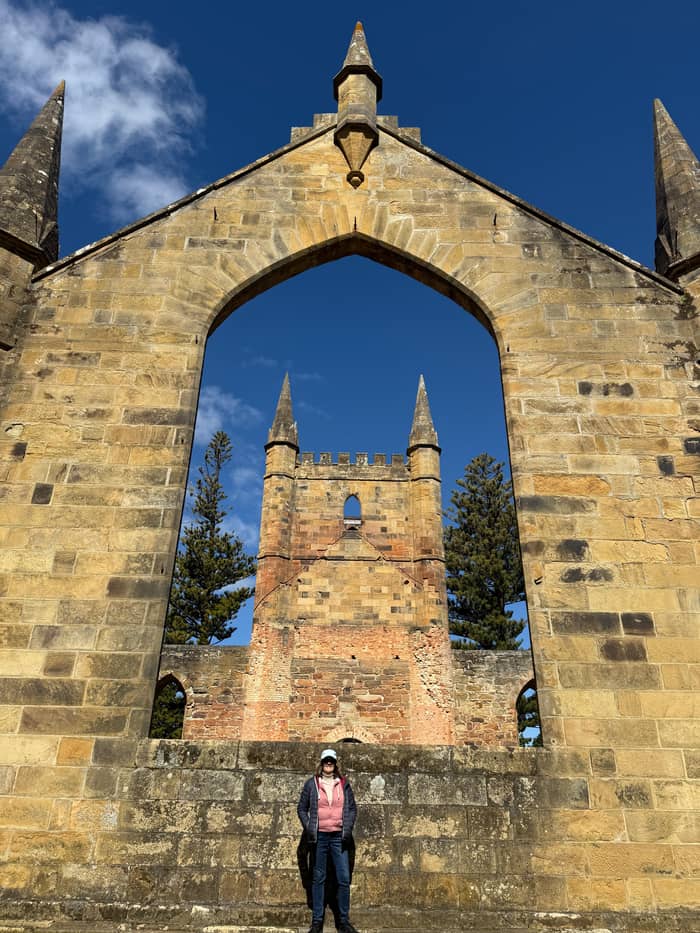
Most detail
Small and deep
Plan this visitPort Arthur was not only a prison. The Commandant's House, the boss's house, is one of the site's museum houses, and the audio guide suggests listening to its episode on the road behind the Penitentiary.17 Free families lived here too, and their story is told along Civil Officers Row.78 Walking from the cells to these furnished rooms in a few minutes shows how close two very different lives were.
The Government Gardens were first laid out in 1846-47 by Commandant Champ.38 After the settlement closed they were neglected, and reconstruction began in 1991.79 Champ had replaced the hop fields in front of Government Cottage with a pleasure garden for the ladies of the settlement.80,81 The audio guide's final episode, on Port Arthur after 1877, is meant to be heard here among the beds and lawns.82
For the best view of the whole settlement, the audio guide suggests climbing Settlement Hill while listening to its episode on transportation.12 From up there the whole settlement spreads out below you, from the waterfront ruins to the houses and gardens. It is a good moment to fix the place in your head before you walk on to the Asylum and the Separate Prison, which stand together at the southern end of the site.83
A walking order
Arrival
Begin downstairs in the Visitor Centre and pick up your playing card.7,8
Waterfront
Walk through the old mill and its 136 cells.16
Behind it
Hear the audio episode on the road behind the Penitentiary.17
Up the hill
See the roofless Convict Church and listen for the bells.18,19
Southern end
Listen to the punishment episode just outside.20
Jetty
Take the 20-minute cruise included in your ticket.4
The Asylum was the last great building project of the convict era, begun in 1864.39 The site's timeline dates the construction to 1864-68, part of a welfare phase that also produced the Pauper's Depot.84 After transportation ended, the government heritage listing notes, the buildings housed convict invalids, paupers and lunatics for many years.85 Today the Asylum holds the quieter cafe, open daily from 11:30am to 3:30pm.86,60
Do not skip the water. Every entry ticket includes a complimentary 20-minute Harbour Cruise, and the departure time can be chosen after checkout.4 The boat goes past the Isle of the Dead and Point Puer, and the admission listing names both. The cruise and the Essentials Tour are both wheelchair accessible, and the MV Marana has full pram access.87,88 On a calm day the short trip on the water is also the best way to see how the settlement sits in its cove, with the hills closing in behind it.
Near the Visitor Centre is the Memorial Garden. Staff prefer not to be asked about the events it remembers; a brochure, information in the Gallery and a plaque in the garden tell that story.61 Walk through it slowly and leave the camera in your bag. The guide talks and tours deal with the convict era, and that is where your questions will be welcomed. Treat the garden the way the site asks, and keep voices low while you pass through.
Video
Dave & Nik's Adventures on YouTube · The clip loads only after you tap play.
Most visitors spend between half a day and a full day exploring the site
On the day
The site's own advice is to allow at least half a day, and its ticket page puts a typical stay at anything from half a day to a whole day.3,47 That is the honest answer to how long to spend at Port Arthur. A short visit is possible: most cruise ships arrive in the early morning and their passengers return around midday.43 But a short visit sees the Penitentiary and the harbour and little else.
A half day covers the Gallery, the Penitentiary, the Separate Prison, the church and the gardens, with one guided tour and the cruise. The Essentials Tour takes about 45 minutes over fairly level ground, with departures every day at 9:30am, 10:30am, 12:30pm or 3:45pm.41,33 Add the audio guide, which holds over 40 minutes of recordings, and you have a well-explained morning or afternoon.32 Keep the harbour cruise for the middle of the visit, when legs need a rest.
A full day adds the Isle of the Dead cemetery tour, a 65-minute experience that begins on the MV Marana, plus an hour on the Escape from Port Arthur tour at 11:00am or 3:00pm.35,34 If that still feels rushed, the entry ticket is valid for two consecutive days, so you can split the visit and stay on the peninsula overnight.46 Doing the buildings on the first afternoon and the island and the harbour the next morning is a far gentler rhythm than cramming them all into one long day, and it leaves the evening free for a ghost tour.
The Port Arthur Visitor Centre cafe opens daily from 9am to 5pm, lunch at the 1830 Restaurant & Bar is served from 11:30am to 2:30pm, and a Picnic Pack can be pre-booked at least one day ahead and collected from 10am.89,90,91 Bringing your own food and drink is fine too.92 Gluten-free, vegetarian, vegan and halal options are available on request, so ask at the counter.93 The Asylum cafe at the southern end of the grounds saves the walk back to the entrance when you are deep in the site.
Dogs are a common question. The site welcomes assistance animals such as guide dogs that are certified, and it notes that non-service dogs are also often on site.94,95 If you are travelling with a pet, contact the site before you go. Smoking is another rule: the whole site has been smoke-free since 2011.96 Drones are a third: recreational drone use is not permitted anywhere on the historic site.97
Port Arthur is large and outdoors, with hills, gravel paths and steps.98 Wheelchairs can be hired on site at no fee, prams can be hired at the Visitor Centre, and some museum houses can only be entered by stairs.99,44,45 Courtesy buggies run between 10:30am and 3:30pm for visitors with limited mobility, and handheld seat rests are available from the Visitor Centre.6,100 Bench seats are spread through the ruins, buildings and gardens, so it is easy to pace a slower visit.
FAQ
It covers more than 40 hectares (100 acres), with gardens and upward of 30 ruins, buildings and house museums.1
Free 10-15 minute guide talks are open to all daytime visitors with entry or a tour.5
Recreational drone use is not permitted at the historic site.97
Its colour comes from tannins in leaves that fall into the reservoir, and it is safe to drink.102
Sources
Also worth reading
Planning a day at Port Arthur? A real person answers here.